

If we’re running off-road machinery for a living, the “best” diesel engine is the one that keeps hydraulic power consistent, starts reliably in rough conditions, and stays serviceable when the nearest shop is hours away. This guide breaks down Duramax vs Cummins for real equipment use—how they differ, where each one fits better, and how to choose based on duty cycle, service access, and hydraulic workload.
Duramax and Cummins Engine Overview
In off-road fleets, we usually don’t choose an engine because it wins a bench-racing argument. We chose it because it supports the way the machine works: long idle, heavy torque demand at low RPM, high heat load, and constant dust and vibration.
Duramax
Duramax is best known as a modern turbo-diesel platform that has seen multiple generations and calibrations. In equipment-adjacent use (repower projects, power units, service rigs that support off-road jobs, and diesel power packages driving auxiliary loads), Duramax engines are often valued for:
- Compact packaging for a high-output diesel (helpful in tight engine bays)
- Smooth power delivery that can feel “clean” across RPM ranges
- Electronics and diagnostics that make fault-finding quicker when you have the right tools
Cummins
Cummins has a long history in commercial and industrial diesel use, including off-highway and equipment applications (varies by platform and certification). In fleet reality, Cummins engines are commonly associated with:
- Strong low-RPM torque behavior (useful for steady pulling and sustained load)
- Straightforward service layout on many inline designs (access can be better)
- Broad parts ecosystem across working industries
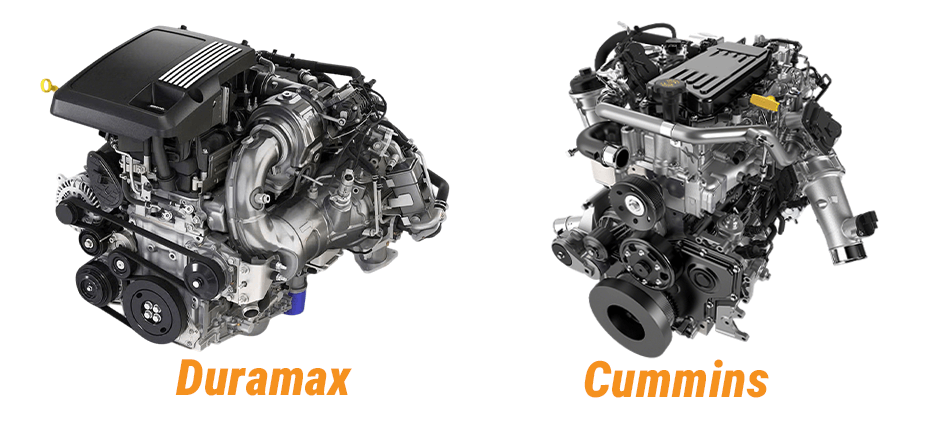
Duramax vs. Cummins: What’s the Difference?
The Duramax vs Cummins comparison gets clearer when you stop thinking like pickup owners and start thinking like equipment owners. Below are the differences that matter on jobsites.
1) Engine layout and packaging
Many common Cummins configurations feature inline-six designs, whereas many Duramax configurations employ V8 designs. In off-road installs, that can affect:
- Access to front-end service items (belts, tensioners, fan drive area)
- Side access to filters, turbo plumbing, and exhaust routing
- How easily can you route intake piping and protect it from dust ingestion
Practical takeaway: If our machine has cramped side access but decent length in the bay, an inline layout can be easier to service. If the bay is short and wide, a V layout may package better—but we still need access plans for filters, belts, and connectors.
2) Torque delivery under hydraulic load
Off-road machines don’t “feel” engine power the same way road vehicles do. What you feel is a hydraulic response:
- Lift speed under load
- Track/wheel drive consistency
- Implement responsiveness at low RPM
- Recovery after sudden load changes (e.g., digging into hard material)
Both platforms can deliver strong torque, but the difference is often how they deliver it and how the calibration behaves under steady load.
3) Electronics, diagnostics, and “field-fix” reality
In off-road environments, a small fault can become a big delay if it stops the machine or derates power. The real comparison is less about “which has more tech” and more about:
- Can you read and interpret code easily?
- Are connectors and harnesses protected from abrasion and heat?
- Are sensors placed where mud and vibration won’t kill them early?
- Do you have a troubleshooting path that doesn’t require swapping parts blindly?
Our rule: the more electronically managed the system, the more you invest in preventive checks—battery health, grounds, harness routing, and keeping connectors sealed.
4) Maintenance access and routine service time
Routine service is where the cost of ownership is won or lost. For both engine families, you plan around:
- Fuel filtration discipline (clean fuel is non-negotiable)
- Air filtration and intake sealing (dust is an engine killer)
- Cooling system cleanliness (radiator and CAC airflow)
- Belt and tensioner inspections (front-end accessory reliability)
To keep this practical, here’s a comparison table focused on off-road priorities.
Off-road decision table: Duramax vs Cummins
| Topic (Off-Road Priority) | Duramax (Typical Pros/Tradeoffs) | Cummins (Typical Pros/Tradeoffs) |
|---|---|---|
| Packaging in tight bays | Often fits well in shorter bays; can be dense to work around | Inline layouts can be easier to access; they may need more length |
| Low-RPM work feels | Can be very smooth; calibration matters for lugging | Often favored for steady low-end pull; calibration matters too |
| Service access | Can be efficient if access panels are designed well | Often a straightforward layout, but it still depends on the machine |
| Diagnostics | Strong when supported with the correct scan tools | Strong ecosystem; still requires correct tooling and data |
| Fuel system sensitivity | High-pressure systems demand clean fuel | Same—clean fuel and filtration discipline are critical |
| Best fit jobs | Mixed-duty cycles, variable load profiles | Sustained load work, steady torque demand, high utilization |
5) The often-missed link: hydraulic system efficiency
Off-road owners sometimes chase “engine choice” while the real bottleneck is hydraulic efficiency. If you’re seeing slow implementations, heat buildup, or weak drive, the culprit may be:
- Worn hydraulic pump
- Internal leakage in a hydraulic motor
- Relief valve issues
- Contaminated fluid is damaging components
- Incorrect pump control settings
This is where engine choice meets real productivity: a great diesel can’t fix a tired hydraulic pump.
Mid-article parts note:
If our troubleshooting points toward hydraulic power loss—slow cycles, weak torque at the drive motors, rising hydraulic temps—checking pumps and motors is often the next step. FridayParts focuses heavily on hydraulic components (pumps, motors, repair kits) used across off-road equipment categories, and it can be helpful to browse Cummins parts when we’re planning a repair window and want compatible aftermarket options ready before teardown.
Which Diesel Engine is Right for You?
Now we turn the Duramax vs Cummins debate into a decision you can actually use on a jobsite. We’ll choose based on workload, service setup, and risk tolerance for downtime.
Step 1: Define the duty cycle
Ask three questions:
1. Is the machine running a sustained load for long stretches?
Examples: pushing, pulling, continuous hydraulic drive, long-duty pumping.
2. Do you need precise control at low RPM?
Examples: fine grading, lifting/placing, controlled trenching.
3. Is the machine working in dust/mud/brush where damage is common?
If yes, service access and protection matter as much as power.
Step 2: Decide based on what you can support
Here’s a practical checklist that often decides for us:
- Tools on hand: Do you have the scan tools and service data for that engine platform?
- Parts availability: Can you source filters, sensors, belts, and common wear items fast?
- Tech support: Do you have a technician who knows the platform well?
- Downtime cost: Is it an unexpected, minor delay, or a serious jobsite penalty?
Step 3: Look for common “uptime killers
Regardless of Duramax or Cummins, the big off-road failure patterns often come from the same sources:
- Air leaks or poor filtration sealing (dust ingestion)
- Fuel contamination (water, fines, microbial growth in storage)
- Overheating due to plugged cooling stacks
- Wiring damage from vibration rub-through
- Hydraulic overheating that overloads the cooling package
You reduce risk with a simple routine:
- Cooling stack cleaning schedule (based on dust conditions, not the calendar)
- Fuel sampling (especially if we store fuel onsite)
- Harness inspection at rub points and near heat sources
- Hydraulic oil cleanliness control (filters, breathers, contamination control)
When you’d lean on Duramax
You tend to lean towards Duramax when:
- Space is tight, and packaging is a big constraint
- You want smooth, predictable power delivery for varied work
- You have a strong diagnostic capability and can protect the electrical system well
When you’d lean Cummins
You tend to lean towards Cummins when:
- You value service access and a “work-first” layout
- The machine spends a lot of time under sustained load
- You want broad compatibility in working-industry parts supply chains
Most owners don’t buy parts while reading the first half of an engine comparison—they buy when they’re planning a maintenance window or chasing a performance issue. If we’re at that stage and our machine’s performance points to hydraulic inefficiency (weak travel, slow implements, heat), it makes sense to line up replacement pumps/motors or repair kits alongside engine service items. FridayParts stocks and tests hydraulic components by flow/pressure tolerance and compatibility across many equipment types—so it’s worth checking Cummins parts during planning, especially if we want aftermarket pricing without gambling on fit.
Conclusion
Choosing Duramax vs Cummins for off-road machinery comes down to uptime, service access, and how the engine behaves under hydraulic load—not brand loyalty. Both platforms can perform well when fuel is clean, cooling is maintained, and wiring/air systems are protected from harsh conditions. The smarter move is matching the engine to the duty cycle, then supporting it with disciplined filtration and cooling maintenance. Aftermarket parts planning can further cut downtime and cost.
