

Choosing an excavator or a bulldozer directly influences the efficiency, construction period, and budget of a project. No matter whether you are carrying out mining operations, land development preparation, or public utility installation, clearly understanding which machine is more suitable for your specific earthmoving work requirements can help you avoid costly delays and equipment mismatches. This guide clarifies the fundamental differences between these two mainstay machines of off-road construction, assisting you in making the correct equipment selection for your operations.
What Is an Excavator and Bulldozer?
Before comparing them, let’s clarify what these machines are and how they perform on an off-road jobsite.
Excavator Overview
An excavator is a hydraulic-powered machine designed mainly for digging, trenching, and lifting operations. It features a pivoting cab (or “house”), a boom, and a dipper arm connecting to a bucket or various attachments, allowing rotation of up to 360°.
Typical off-road uses include:
- Digging foundations and trenches on rugged terrain
- Moving materials between dump zones
- Demolishing old structures or rock faces
- Mining and material extraction
Thanks to their hydraulic systems and versatility, excavators perform tasks that require precision rather than brute pushing power.
Bulldozer Overview
A bulldozer—often shortened to dozer—is a rugged track-based machine with a front blade designed for pushing, leveling, and clearing large areas of soil or debris. Bulldozers have excellent traction and stability, making them ideal for off-road terrains like clay, gravel, or forested areas.
Common applications include:
- Land clearing and surface leveling
- Roadbed preparation and grading
- Pushing heavy loads such as rocks or woody debris
- Creating slopes or reshaping uneven landscapes
A bulldozer’s power comes from its low-speed, high-torque engine, able to move massive materials efficiently on difficult terrain.
For a full range of bulldozer parts — including hydraulic systems, undercarriage parts, and cooling components — FridayParts supplies durable aftermarket solutions for major brands like Komatsu, John Deere, and Case.
Types of Excavators
| Type | Key Features | Ideal Job Type |
|---|---|---|
| Crawler Excavator | Tracks for stability and heavy lifting | Mining, trenching, or major excavation |
| Mini Excavator | Small and flexible with a reduced tail-swing radius | Residential or confined off-road spaces |
| Long-Reach Excavator | Extended boom for far-reach digging | Dredging or distant trenching |
| Skid Steer Excavator | Wheeled maneuverability | Debris removal and light excavation in confined sites |
In off-road environments, crawler and mini excavators dominate for their balance of stability, digging depth, and power.
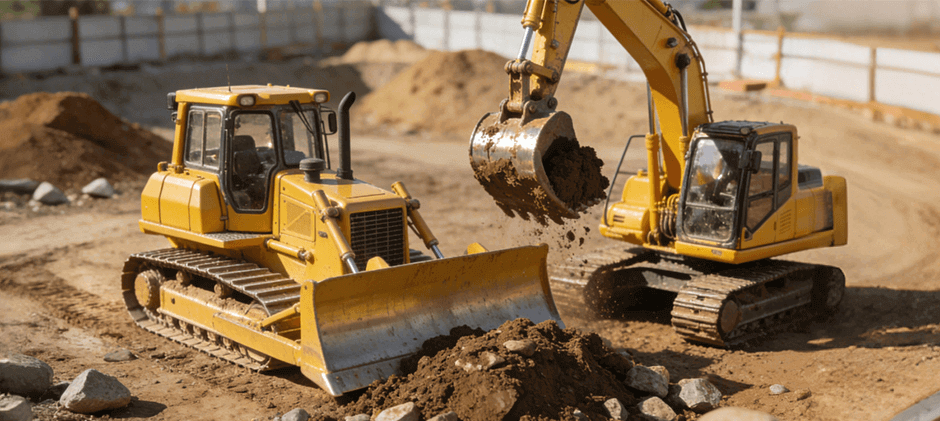
Equipment Comparison: Excavator vs Bulldozer
This is where the choice becomes clear—especially for owners managing uptime, wear items, and operator hours.
1) Work output: push-and-shape vs dig-and-place
A dozer’s blade is built to push and shape large volumes across the ground. That makes it dominant in:
- stripping
- rough grading
- spreading fill
- building working platforms
An excavator is built to dig and place material precisely:
- trenches with consistent depth
- holes with clean walls
- loading cycles (dig → swing → dump)
If you try to force an excavator to clear large areas by “scooping and swinging” every obstacle, it usually becomes slower than a dozer push pass. And if you try to force a dozer to do deep trenching, you often get overbreak, poor trench shape, and rework.
2) Precision and control
Excavators generally give us better control over:
- trench width and grade
- digging around utilities (with proper locating and safe practices)
- placing material into trucks, bins, or forms
Dozers can be very accurate for grading in the hands of a skilled operator, but the blade is still a surface tool. For below-grade accuracy, excavators typically win.
3) Terrain and access
Terrain drives productivity more than most people expect.
- Dozers (especially tracked) handle traction-demanding pushes well, but they want room to work efficiently—longer runs and cleaner travel lines.
- Excavators handle uneven work zones well because they can dig and swing without traveling much. That’s a huge advantage in cluttered off-road sites.
If the site is tight, congested, or segmented, an excavator (or compact excavator) often keeps production steadier than a dozer that’s constantly turning, reversing, and resetting.
4) Material handling and “where the dirt goes.”
A key difference:
- A dozer moves material on the ground.
- An excavator moves material through the air (lift/swing/dump).
That changes our plan:
- If you must load trucks, stockpile over berms, or place material on one side of a trench, the excavator’s lift and swing motion is the clean solution.
- If you need to spread and blend material across a pad, the dozer is usually faster and leaves a better rough grade.
5) Attachments and versatility (real-world view)
Owners often pick excavators because attachments can turn one base machine into many tools. Common attachment-driven tasks include:
- trenching buckets for utilities
- breakers for rock or demolition
- thumbs and grapples for handling debris
- augers for holes (fence lines, footings)
- couplers for fast changes
Dozers are more specialized, but that specialization is valuable: fewer “tool changes,” more consistent output for pushing and grading.
6) Operating cost: wear points and maintenance reality
For off-road owners, “which is cheaper” depends on wear patterns and maintenance discipline, not just fuel.
Dozers commonly rack up wear on:
- undercarriage components (tracks, rollers, idlers)
- cutting edges and blade wear parts
- drivetrain-related components under heavy pushing loads
Excavators commonly rack up wear on:
- bucket teeth and cutting edges
- pins/bushings and linkage wear points
- hydraulic system components (hoses, seals, filters)
This is also where parts planning matters. If you keep common service parts on hand—filters, seals, sensors, and other maintenance items—we reduce downtime and avoid “small failures” turning into expensive damage. For owners who want a fast way to stock common replacements, browsing dedicated catalogs for bulldozer parts is a practical step—especially when you’re managing multiple machines and want compatible aftermarket options without overpaying.
7) Quick comparison table
| Category | Bulldozer | Excavator |
|---|---|---|
| Primary strength | Pushing, spreading, rough grading | Digging, lifting, placing, loading |
| Best movement pattern | Forward push passes | Dig–swing–dump cycles |
| Typical “best day” tasks | Clearing, pad prep, slope shaping | Trenching, foundations, loading, demolition |
| Works well in tight sites | Sometimes limited (needs push lanes) | Often strong (rotating upper body) |
| Material handling | Moves material along the ground | Moves material by lifting and swinging |
| Where we feel rework risk | Deep trenches and tight tolerances | Large-area clearing and finish shaping (without support) |
| Maintenance focus | Undercarriage + cutting edges | Hydraulics + bucket wear + linkages |
How to Choose Between an Excavator and a Bulldozer?
The right choice depends on the type of work, terrain, and operational priorities of your off-road project.
Choose an Excavator If:
- You’re digging deep trenches, holes, or foundations.
- You need controlled movements for precise operations.
- The jobsite requires maneuverability on slopes or uneven ground.
- You need quick attachment swapping for multiple tasks.
Choose a Bulldozer If:
- You’re clearing dense land or forestry areas.
- Grading and leveling are top priorities.
- Ground conditions are rough, and natural traction is key.
- Heavy lifting is less important than pushing capacity.
Here’s a quick summary:
| Condition | Best Machine |
|---|---|
| Large-scale clearing, grading | Bulldozer |
| Deep digging, trenching | Excavator |
| Off-road terrain with elevation | Excavator |
| Flattening soil for routes | Bulldozer |
| Material handling | Excavator |
Final Thoughts
Choosing between a bulldozer and an excavator isn’t about which is “better” overall — it’s about which tool fits your terrain and job demands.
- Bulldozers: unmatched for land clearing and grading.
- Excavators: superior for digging, lifting, and versatile off-road operations.
For off-road machinery owners, one long-term strategy remains universal: reliable parts equal reliable performance. Upgrade, repair, and maintain your heavy equipment with high-quality aftermarket parts designed for durability and affordability from FridayParts — your global one-stop shop for dozer, skid steer, and excavator components.
