

When a V-belt breaks on your off-road machine, everything stops. If the markings on the old belt are worn off, it can be hard to know what to replace it with. Luckily, finding the right belt is simple when you know how to use a size chart and take two quick measurements. This guide shows you how to identify any V-belt easily so you can choose the correct one and get your machine back to work fast.
What Are the Main V-Belt Types?
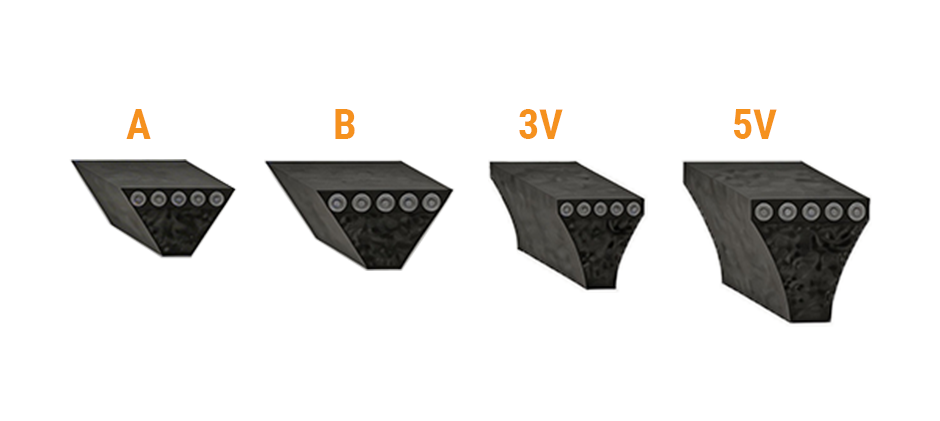
V-belts come in different shapes and sizes, known as “sections.” These sections are defined by the width and height of the belt. Knowing the type of belt is the first step to picking the right one for your machine.
Classical V-Belts (A, B, C, D)
These are the most common belts found in farming, construction, and industrial machines. They are labeled with letters like A, B, C, and D to show their width and strength. For example, a “B55” means it’s a B-type belt that is 55 inches long inside. Some belts have small notches (called cogged belts, like AX or BX) that make them bend more easily and run cooler on smaller pulleys.
Narrow V-Belts (3V, 5V, 8V)
Narrow V-belts deliver more power in a compact space. Their deeper profile provides superior grip, making them perfect for the high-torque demands of heavy-duty machinery like rock crushers and large pumps. A “5V800” signifies a 5V-type belt with an 80.0-inch outside length. Cogged versions (3VX, 5VX) are available for even greater performance under heavy loads.
Fractional Horsepower (FHP) V-Belts (3L, 4L, 5L)
FHP belts are designed for light-duty applications, like small fans, service pumps, and lawn equipment. While a 4L belt may have the same top width as an A-type belt, its shallower profile means it is not strong enough for heavy-duty use and cannot replace industrial-grade belts.
How to Identify Your V-Belt in 2 Simple Steps
You don’t need the old part number to find the right belt. Just measure the top width and outside length, then use the chart below to match your belt type and size.
Step 1: Measure the Top Width to Find the Type
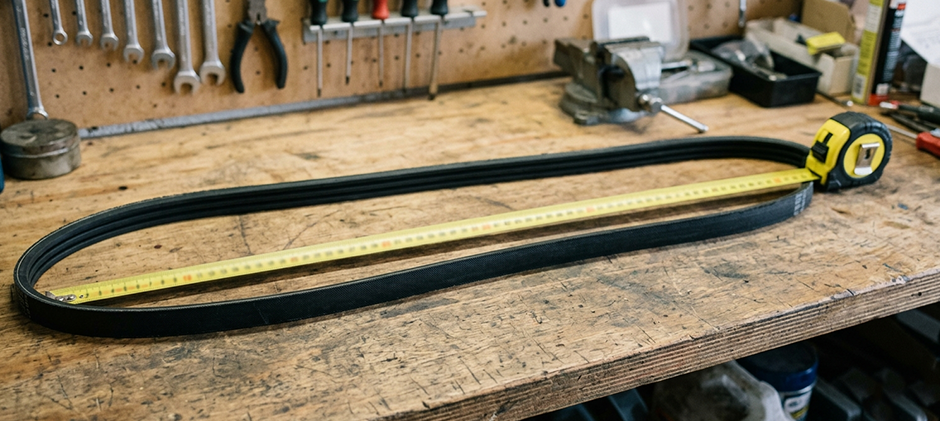
First, use a caliper to measure the widest part of the belt — this is the “top width.” This measurement tells you which belt type it belongs to, such as A, B, or 5V. Once you know the width, look it up on the chart to find its family. Remember this simple rule: the width tells you the belt type, and the length tells you the size.
Step 2: Measure the Outside Circumference for the Length
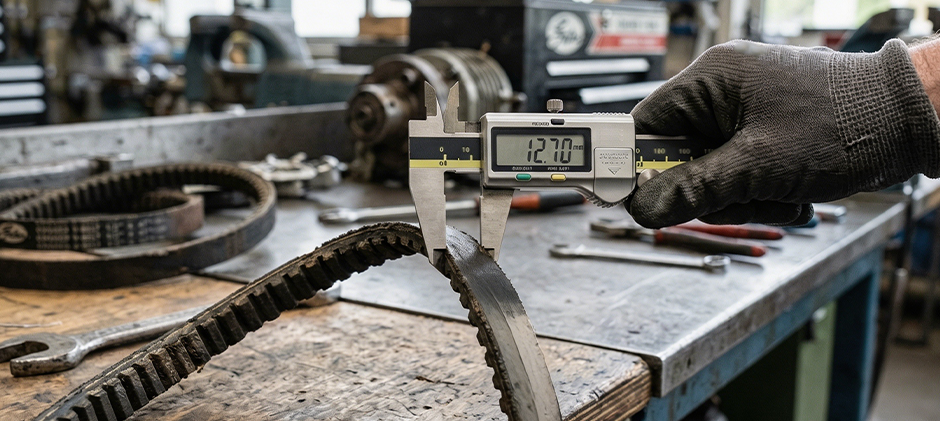
After identifying the belt type, measure its length. For an intact belt, use a flexible tape measure to find its outside circumference. If the belt is broken, simply measure it from end to end. This length, combined with the belt type from Step 1, allows you to find the correct replacement.
The V-Belt Profile Identification Chart
This chart helps you match your top width measurement to the correct belt type. It’s a quick reference to make sure you identify the right shape and section before ordering a new belt.
| Belt Type | Top Width (Inches) | Top Width (mm) | Profile Drawing |
|---|---|---|---|
| 3L (FHP) | 3/8″ | 9.5 mm | (Shallow V-shape) |
| A / 4L | 1/2″ | 12.7 mm | (Standard V-shape) |
| B / 5L | 21/32″ | 16.7 mm | (Wide V-shape) |
| C | 7/8″ | 22.2 mm | (Extra wide V-shape) |
| 3V (Narrow) | 3/8″ | 9.5 mm | Deep profile for heavy-duty tasks |
| 5V (Narrow) | 5/8″ | 15.9 mm | (Deeper, narrow V-shape) |
| 8V (Narrow) | 1″ | 25.4 mm | (Deepest, narrow V-shape) |
Important Note: If you measure a top width of 3/8″, it could be a 3L or a 3V belt. Look at the belt’s depth: a 3V belt is noticeably deeper and feels more rigid than a shallow 3L belt.
Why Choose a Cogged V-Belt?
Cogged V-belts are a smart improvement for most machines. The small notches help the belt bend around tighter pulleys and release heat more easily. This makes them last longer, run cooler, and reduce wear on both the belt and pulleys. If your machine often works in hot or dusty off-road conditions, a cogged belt (like BX or 5VX) can be a better choice for performance and durability.
Quick Q&A
While both have a 3/8″ top width, the 3V belt is significantly deeper and more rigid, designed for high-torque heavy-duty industrial tasks. The 3L belt has a shallower profile and is intended for fractional horsepower (FHP) applications like small fans or lawn equipment.
Cogged V-belts feature notches that allow them to bend more easily around small pulleys and dissipate heat more efficiently. This leads to a longer lifespan, cooler operation, and reduced wear on your machine’s components, especially in hot or dusty off-road conditions.
Conclusion
Choosing the right belt doesn’t have to be hard. Measure the width, find your belt type, then measure the length to confirm the size. This simple method ensures you order the correct replacement on the first try and reduces downtime.
To keep your equipment strong and reliable, take a look at durable heavy-duty belts from FridayParts. These belts are built for tough off-road conditions and help your machine keep running smoothly after a job.
