

Is your Briggs & Stratton engine surging, blowing black smoke, or refusing to start when cold? You are not alone. Linkage issues are among the most common reasons lawn mowers and tractors end up in repair shops. While many owners assume their carburetor is ruined, the real culprit is often a simple, misaligned metal rod or a stretched spring. In this guide, we will break down the Briggs & Stratton choke and governor linkage diagram. And we’ll show you how the single-cable system operates and provide a step-by-step adjustment guide. Read on to discover the exact hookup points and get your engine running smoothly again today!
Briggs and Stratton Choke Linkage Diagram
Understanding the choke and governor linkage of your Briggs and Stratton engine is essential for reliable performance, preventing engine surging, and ensuring easy starts. In this part, we’ll break down the key components of a popular Briggs and Stratton 540cc engine (Choke-A-Matic), explain how the single-cable system works, and show you exactly how to adjust it.
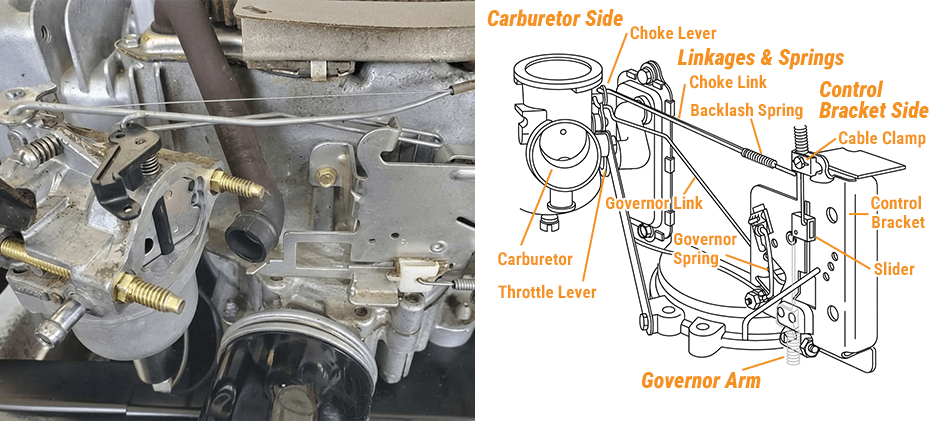
Key Components in the Briggs & Stratton Choke Linkage Diagram
The diagram above shows the Choke-A-Matic of the Briggs and Stratton Engine. If your engine uses the same setup, you can follow the diagram to trace your connections. We’ll illustrate the functions of key components of a common Briggs and Stratton choke and governor linkage diagram to help you understand how they work together:
- Choke Lever: Controls the choke plate inside the throat of the carburetor. During a cold start, it restricts airflow to create a richer fuel-to-air mixture. If you are having trouble locating your carburetor ports, check out our comprehensive Briggs and Stratton Carburetor Diagram Guide to identify every fuel and air inlet.
- Throttle Lever: Controls the throttle plate (butterfly valve) inside the carburetor, regulating the amount of air-fuel mixture entering the engine to determine engine speed.
- Choke Link: The longest solid metal rod that directly connects the Choke Lever on the carburetor to the remote control bracket.
- Governor Link: Aka throttle link, is the solid metal rod that connects the Carburetor Throttle Lever to the Governor Arm, allowing the governor system to mechanically adjust engine speed.
- Backlash Spring: A fine, light-tension spring wrapped around the Governor Link. It eliminates play (backlash) in the linkage joints, preventing throttle flutter and engine surging.
- Governor Spring: The heavy-duty main spring that applies tension to the Governor Arm. It counteracts the centrifugal force of the internal governor flyweights to maintain the desired engine speed under varying loads.
- Control Bracket: The stationary metal mounting plate that houses the throttle cable clamp, slider mechanism, and choke actuation points.
- Governor Arm: The heavy metal lever clamped to the governor cross shaft protruding from the engine crankcase. It balances the opposing forces of the Governor Spring and the internal governor flyweights to automatically regulate the throttle.
Briggs and Stratton Choke Linkage Diagram (Other Control Methods)
Depending on your equipment, your engine might use a different control design. If you use a single-lever control (manual choke) or a dual-cable control (remote choke), refer to the diagrams below:
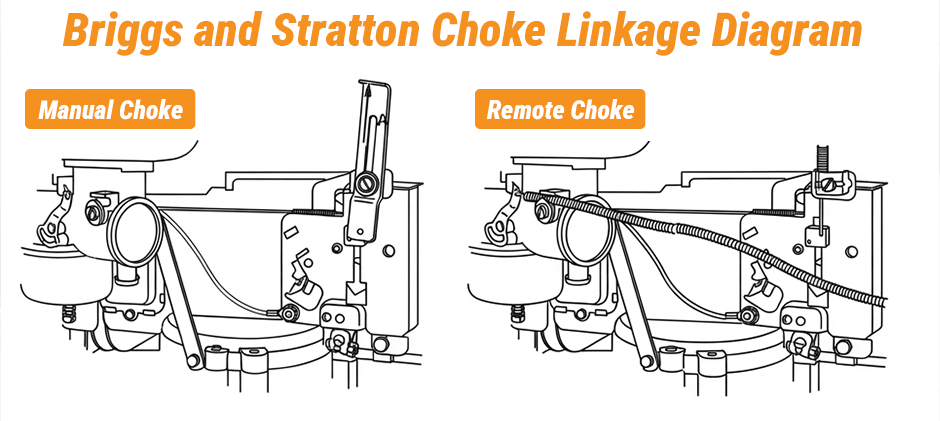
*Crucial Tip: It is extremely easy to mix up the Choke Link and the Throttle Link during reassembly. If your engine is running wide open or won’t respond to the throttle, refer to our Briggs and Stratton Throttle Linkage Diagram to ensure your rods are connected to the correct holes. If your spring is stretched, rusted, or hooked into the wrong hole, your engine will experience severe “surging” (revving up and down). Learn how to install the spring in our Briggs and Stratton Governor Spring Diagram Guide.
How to Adjust Remote Choke Control?
- Loosen the choke control wire casing screw on the remote choke mounting bracket.
- Move the equipment choke control lever or knob to CHOKE.
- Move the engine choke control lever to CHOKE.
- Move the choke control wire and casing to close the choke completely.
- Securely tighten the casing clamp screw.
- Operate the choke control to confirm proper operation.
What Is Choke Off /Open?
One of the most common points of confusion for beginners when looking at a carburetor is understanding the difference between the Choke ON and Choke OFF positions.
The choke is a butterfly valve located at the air intake entry of the carburetor. It has two distinct operating states:
- Choke ON / Closed (Cold Start): The valve rotates to block the air intake, restricting airflow while allowing fuel to flow normally. This creates a highly concentrated, “rich” fuel-to-air mixture, which is essential for starting a cold engine.
- Choke OFF / Open (Normal Running): The butterfly valve rotates to a fully vertical position (parallel to the airflow), allowing air to flow freely into the engine. This provides the standard fuel-to-air ratio required for a warmed-up engine to run smoothly and deliver full power during mowing.
How Does the Single-Cable Linkage System Work?
Most modern walk-behind lawn mowers use a single-cable control system. This means one throttle lever on the handlebar controls both the engine speed (throttle) and the choke. Here is how they work together:
- Activating the Choke (Cold Start):
When you push the handlebar throttle lever all the way forward—past the “Fast/Rabbit” icon into the “Choke” position—the Slider on the control bracket moves to its absolute limit. This action mechanically pushes the Choke Link forward, forcing the Choke Lever to close the valve (Choke ON).
- Deactivating the Choke (Normal Operation):
Once the engine fires up and starts running, you must pull the handlebar lever back slightly into the “Fast/Rabbit” operating range. This movement pulls the Choke Link back, causing the choke butterfly valve to spring fully open (Choke OFF / Open).
Tips: If your engine starts but immediately sputters and dies with black smoke, or if it won’t start at all when warm, your choke linkage might be misadjusted, keeping the valve in the Choke ON position when it should be Choke OFF (Open). Always ensure the valve opens fully once the engine is running!

Troubleshooting Quick-Table
| Symptom | Potential Linkage Issue | What to Check |
|---|---|---|
| Engine won’t start when cold | Choke is not closing fully | Check if the Choke Link is bent or if the remote cable needs adjustment. |
| Engine starts but smokes black and dies | Choke is stuck ON | Ensure the Choke Lever springs back to the Open/Off position when throttle is moved to “Fast”. |
| Engine speed fluctuates | Missing or damaged springs | Inspect the Backlash Spring and Governor Spring for tension loss. |
Wrapping up
Mastering your Briggs and Stratton engine’s linkage system is the secret to your maintenance. By ensuring your choke opens fully and your governor springs have the correct tension, you can prevent annoying engine surging and ensure quick, one-pull starts every single time. Yet if you find your springs are permanently stretched, your links are badly bent, or your carburetor is rusted beyond repair, adjustments alone won’t do the trick. Visit FridayParts to find quality replacement carburetors, governor springs, linkage rods, and throttle cables for your Briggs & Stratton engine. With our extensive inventory of aftermarket parts for Briggs & Stratton engines, you’ll get your equipment back to work in no time!
