

Jump-starting a lawn mower can be a quick way to get it running when the battery is dead. But if the battery keeps dying, it may be time to replace it. So, can you jump a lawn mower battery with a car when you have no other option? Yes. But there are a few important things to check before you do it. In this guide, we’ll cover what to keep in mind and walk you through the process step by step.
What to Consider Before Jump-Starting a Lawn Mower With a Car?
Before grabbing your jumper cables, double-check a few key things to avoid hurting yourself or breaking your mower. Jumping a lawn mower isn’t the same as jumping a car—their electrical setups are totally different.
- First off, make sure the car engine is completely off. This is important. A running car’s alternator puts out way more power than your mower’s charging system can take. If you leave the car running while jump-starting the mower, the extra voltage and current can fry the mower’s electrical parts, like diodes and other electronics.
- Confirm voltage compatibility. Most riding mowers and cars run on 12V batteries, so they match up fine. But some old, small machines use 6V batteries. Never jump a 6V battery with a 12V battery—this overloads the small battery and ruins it or the mower’s electric parts. If you’re unsure, check the sticker on your mower battery or flip through the owner’s manual.
- Car and mower batteries are designed for different jobs. Car batteries pump out huge bursts of cold cranking amps (CCA) to start big vehicle engines. Lawn mower batteries only need a small amount, usually 145 to 300 CCA. Jumping correctly with a car battery works fine, but this difference shows just how much stronger the car battery is.
- Prioritize personal safety. Lead-acid batteries hold corrosive acid and release flammable hydrogen gas. Throw on safety glasses and thick work gloves before you start to block acid splashes and stray sparks. Work somewhere with fresh air, and stay far from open flames or anything that can spark.
How to Jump-Start a Lawn Mower With a Car?
Once you’ve double-checked the voltage and got all your safety gear ready, you can start jump-starting. The order you hook up and take off the jumper cables really matters—it stops sparks and electrical damage. Stick closely to these steps.
Step 1: Get Mower and Car Ready
Park the car near the mower so the jumper cables reach easily, but make sure the two machines don’t touch each other. Shut the car engine off all the way and pull the key out. Turn the lawn mower off too. Hit the parking brake on both the car and the mower. Take a quick look at the dead mower battery—check for cracks or acid leaks. If you spot any damage, don’t try jumping it; you’ll need a new battery instead.
Step 2: Connect the Jumper Cables in the Correct Order
This order is designed to minimize the risk of sparks, especially near the battery.
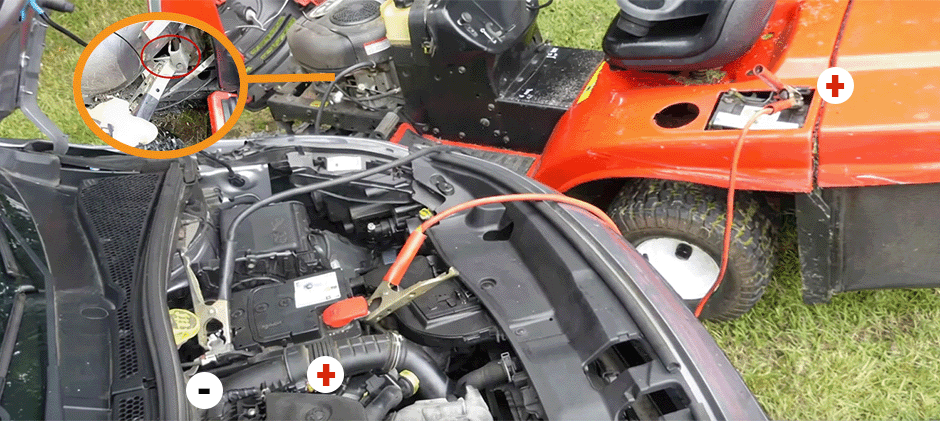
- Connect one red (positive) clamp to the positive (+) terminal of the dead lawn mower battery.
- Connect the other red (positive) clamp to the positive (+) terminal of the car battery.
- Connect one black (negative) clamp to the negative (-) terminal of the car battery.
- Connect the final black (negative) clamp to an unpainted metal part of the lawn mower’s frame or engine block, away from the battery and the fuel system. This is called grounding and it safely completes the circuit. Attaching it away from the battery prevents any potential sparks from igniting hydrogen gas.
Step 3: Start the Lawn Mower
With the cables securely connected, wait a minute or two to let a small amount of surface charge build on the dead battery. Now, try to start the lawn mower as you normally would. It should turn over. Do not crank it for more than a few seconds at a time to avoid overheating the starter motor.
Step 4: Disconnect the Jumper Cables Safely
Once the mower is running, you need to disconnect the cables in the exact reverse order of how you connected them. This is vital for safety.
- Disconnect the black clamp from the mower’s frame.
- Disconnect the black clamp from the car’s negative terminal.
- Disconnect the red clamp from the car’s positive terminal.
- Disconnect the red clamp from the mower’s positive terminal.
Be careful not to let the clamps touch each other or any metal surfaces while they are connected to a battery.
Does Jump-Starting Recharge a Lawn Mower Battery?
No, a jump-start does not recharge your lawn mower battery; lots of people get this wrong. A jump just borrows quick power from a healthy battery to fire up your dead one. It only gives enough energy to crank the engine.
Once the mower’s running, its own charging system will begin to slowly recharge the battery. But this system’s only made to keep a healthy battery topped off, not fix one that’s totally drained. Running the mower for 30 minutes might put a little power back, but it won’t be enough. To restore the battery to full health and prevent it from dying on you again, you must connect it to a proper battery charger after you’re done mowing.
Smarter Alternatives to Jump-Starting Your Mower
While a jump-start works in a pinch, it should be a last resort. There are far better and safer methods for dealing with a weak or dead battery.
- Battery Chargers & Maintainers: A dedicated battery charger is your best bet. If you want your battery to last a long time, a trickle charger or battery maintainer is a must-have tool. These units send out a slow, gentle, low-amp charge. They safely fill the battery all the way up, then hold its charge without overcharging it. They work great for keeping your battery in good shape all winter when the mower’s sitting unused.
- Portable Jump Starters: Also known as jump packs, these are compact, lithium-ion power banks with built-in jumper cables. They are a fantastic investment. They are safer than using another vehicle because they are designed to deliver a controlled burst of power. They are also incredibly convenient, as you don’t need to pull a car up to your mower.
- Professional Help: If you’re not comfortable with any of this, don’t hesitate to seek help. Many auto parts stores will test and even charge your battery for free. This is also a great way to confirm if your battery is actually bad or just needs a good charge.
Battery Maintenance Tips
Want to skip the whole hassle of jump-starting your mower? Just stay on top of regular battery care, and a well-looked-after battery can last you several years.
- Keep terminals clean: Every so often, check your battery posts for crusty white powdery corrosion. Scrub it away with a wire brush and baking soda mixed with water to keep solid power connections.
- Winter storage tips: Don’t leave the battery sitting in your mower all winter inside a cold shed. Cold weather drains lead-acid batteries fast, and it can even freeze and crack the casing. Pull the battery out, store it somewhere cool and dry off concrete floors—like your basement or garage—and hook it up to a battery maintainer.
- Get it tested when it’s time: Mower batteries take a beating from constant shaking, so they usually only last 3 to 4 years. If your battery hits that age and struggles to turn over the engine, bring it to an auto parts shop for a load test. That’s the only surefire way to check if it can still hold a steady charge under load.
- Pick a reliable replacement battery: When you need a new one, grab a model with a high CCA rating for its size. AGM batteries are another great pick too. They handle vibration way better, come fully sealed, and are a tough, zero-maintenance upgrade for most lawn mowers.
Conclusion
You can use a car to jump-start a lawn mower, but make sure the car engine is turned off and follow the correct steps. Still, this should only be a temporary fix. A better option is to use a battery maintainer and keep the mower battery in good shape. If you need replacement parts for your mower, FridayParts can help. We offer parts compatible with many popular lawn mower brands, with plenty of options at affordable prices.
