

Cold morning? Fuel injection fires right up. It’s light on fuel and doesn’t get thrown off by heat, cold, or heavy loads. But if cheap parts and simple wrench work matter more to you, a carburetor is still hard to beat. The choice between carburetor vs fuel injection isn’t just about specs—it’s about what works for your equipment and your routine. And for most people, this isn’t a theoretical decision about which system is “better.” It’s a practical one: what are you willing to put up with—fussy starts, fuel issues, downtime, and repair bills all add up.
How Do Carburetors and Fuel Injection Systems Deliver Fuel?
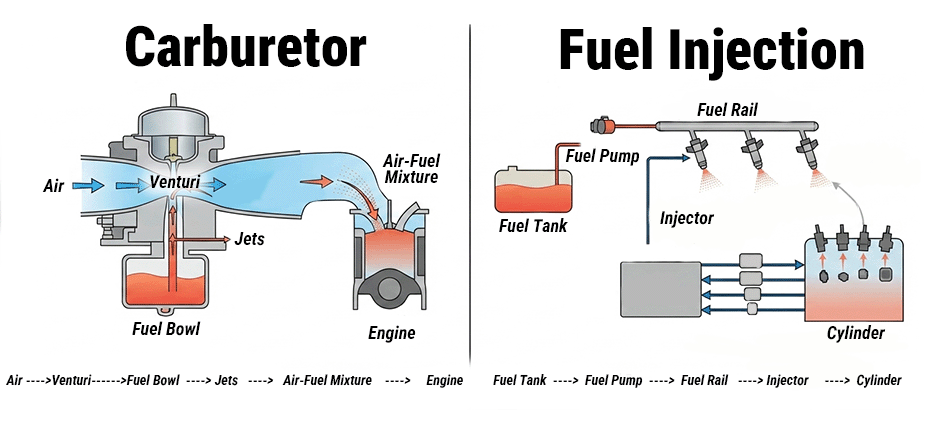
Both systems do the same job: get the right amount of fuel into the engine. They just do it in very different ways.
| System | How It Works | Key Trait |
|---|---|---|
| Carburetor | Measures fuel mechanically. Air moves through the carb, pressure drops, and fuel gets pulled through jets into the airstream. | Old, simple, still effective. Easy to trace problems: dirty jet, stuck float, worn gasket. |
| Fuel Injection | Does the job with pressure and control. A pump sends fuel through, an injector meters delivery precisely. Sensors adjust flow based on temperature, throttle, and load. | More precise. Keeps the engine running cleanly without constant adjustment. |
That difference shows up fast in day-to-day use. A carburetor is easier to take apart on a bench. Fuel injection is better at keeping the engine running cleanly without constant adjustment. In construction equipment maintenance, this distinction directly affects how you approach routine servicing and troubleshooting on the job.
Carburetor vs Fuel Injection: Pros and Cons
The gap between carburetor and fuel injection becomes obvious once you stop looking at diagrams and start looking at how equipment actually behaves in the field.
Starting, Warm-Up, and Everyday Use
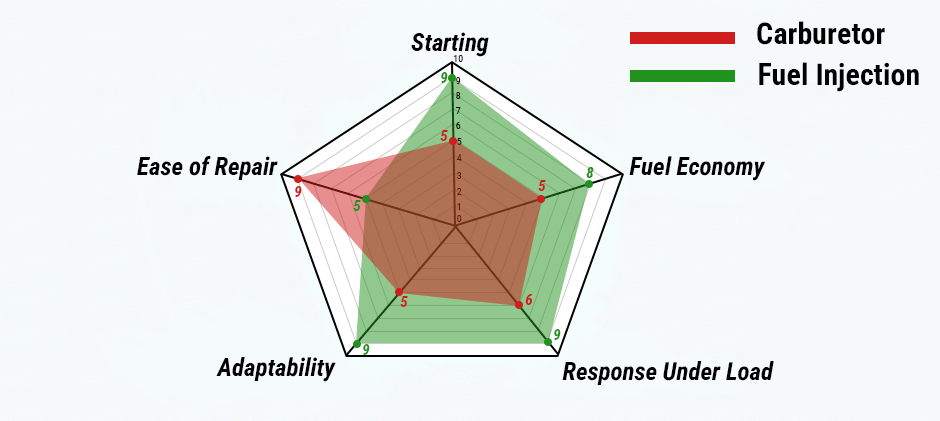
Fuel injection is better on starts. Cold mornings, long idle periods, and changing weather are where it earns its keep. Turn the key, and the engine is more likely to fire quickly and settle down without much drama.
A carburetor can run just as well once it’s sorted, but it’s less forgiving. Anyone who has dealt with a carbureted generator or mower that sat for months with ethanol fuel knows the pattern: hard start, rough idle, maybe a little surging, then a teardown if the bowl or jets have varnished up.
That’s one reason EFI has become so common on newer equipment. Not because carbs can’t run well, but because carbs are far more sensitive to sitting, fuel quality, and adjustment.
Fuel Economy and Response Under Load
If the engine runs for long hours or sees changing loads, fuel injection has the edge. It meters fuel more accurately, so the engine wastes less and responds faster when the workload changes.
You’ll notice that most equipment doesn’t live in one steady operating range. A small tractor moving from light transport work into heavier PTO load, or a commercial mower running through wet grass in the afternoon, puts more demand on the fuel system than a machine cruising under stable conditions. EFI handles those shifts better.
A carburetor does fine when the job is predictable. Where it starts to show its limits is when temperature, elevation, or load keeps moving around. Then you’re more likely to feel hesitation, smell rich running, or notice that the engine just doesn’t feel as crisp. When you weigh carburetor vs fuel injection for your operation, ask yourself how much your daily work varies.
Which Is Easier to Maintain and Repair?
This is where the carburetor still wins, and it’s the main reason carbs are not going away anytime soon. A carburetor is easier to inspect, clean, and rebuild. If the engine is flooding, starving for fuel, or idling poorly, the repair path is usually pretty direct. Pull the carb, open it up, clean the passages, check the float, replace the gasket set, and see what changed. On many machines, that’s a same-day repair.
That matters for owners who do their own work. A carb on a seasonal mower, older generator, or compact machine can often be brought back with a carburetor rebuild kit, fresh fuel, and a cleaned air filter.
Fuel injection usually asks for less routine fiddling, but when it fails, it can be more frustrating to diagnose. A weak fuel pump, a damaged connector, a clogged fuel injector, or a restricted fuel filter can all cause similar symptoms, and the problem is often not visible without proper testing. You may need pressure checks or electrical diagnosis before you know what part actually failed. Once the faulty component is identified, replacing it with a quality fuel pump, connector, fuel injector, or fuel filter is the most reliable fix. You may need pressure checks or electrical diagnosis before you know what part actually failed.
So the difference is simple:
| Carburetor | Fuel Injection | |
|---|---|---|
| Attention needed | More over time | Less day-to-day |
| Repair difficulty | Easier to fix by hand | Harder to chase faults |
For a homeowner or small operator who would rather fix a problem with hand tools than trace wiring or fuel pressure, that still matters a lot. In construction equipment maintenance, this trade-off is especially relevant for small fleets where in-house repair capability is a key factor. Your pick between carburetor vs fuel injection often comes down to who turns the wrenches.
Also Read:
- Ultimate Fuel Injection Pump Replacement Guide: Take CASE 621 as an Example
- How To Clean A Carburetor Without Removing It (Off-Road Machinery)
Cost: Up Front vs Over Time
A carburetor is cheaper to build, cheaper to replace, and usually cheaper to understand. That makes it attractive on older machines and lower-cost equipment.
Fuel injection costs more at the front end, and the repair path can cost more too. But if the machine sees regular use, the payoff is better starting, cleaner fuel control, and fewer day-to-day annoyances.
That’s why the “better” system depends heavily on the machine. On a commercial unit that runs constantly, EFI makes a strong case. On a machine that gets used lightly and repaired at home, a carburetor may still be the smarter choice.
Should You Keep a Carburetor or Upgrade to Fuel Injection?
If your current carbureted machine starts well, runs clean, and is used in fairly steady conditions, there may be no good reason to change it. A lot of owners spend money chasing an upgrade when what they really need is a proper cleaning, fresh fuel, and a few basic replacement parts.
Keeping the carburetor makes sense when:
- You want the simplest repair path
- The machine is older and already set up for it
- You don’t mind occasional cleaning or tuning
- Lower parts cost matters more than convenience
An upgrade starts to make more sense when:
- The machine is used heavily
- Starting consistency matters every day
- Repeated carb problems are eating up time
If equipment works through seasonal temperature swings, changing loads, or long operating hours, fuel injection is easier to live with.
Still, not every upgrade pays off. If this is a backup generator that runs a handful of times a year, or an older mower you can repair in your garage, EFI may be more complexity than you need. If it’s a machine that has to start every morning and keep working without excuses, the balance shifts. These are the kinds of real-world judgments that come up daily in construction equipment maintenance planning.
Final Words
For most modern equipment, fuel injection is the better system. Fuel injection gives you easier starting, better adaptability, and less fuel waste. Carburetors still make sense if you’re after something simple to fix and cheap to buy, rather than perfect refinement. And often, the best fix isn’t a full conversion—it’s just replacing the pieces that have worn out in your current setup. Whether you’re running carbureted or EFI equipment, FridayParts has what you need to keep your machines working and your operation moving.
