

Do lawn mowers take regular gas? Yes, the vast majority of gas-powered lawn mowers run perfectly fine on regular unleaded gasoline straight from the pump. Keep reading to learn exactly what fuel your mower needs and how to store it properly.
What Kind of Gas Does a Lawn Mower Take?
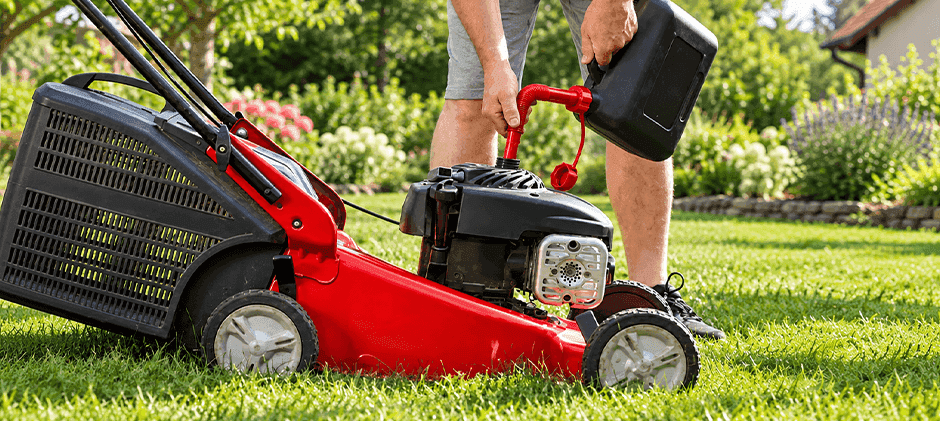
For filling your lawn mower tank, regular unleaded gas is almost always your best pick. Most 4‑stroke mower engines run fine on 87‑octane fuel — the same gas you put in your everyday car.
Lots of people think premium gas will make the mower run faster, cut grass cleaner, or help the engine last longer. That’s not true. Higher‑octane gas only stops engine knock for high‑compression motors. Lawn mowers use low‑compression engines, so buying premium does nothing extra. You just waste extra cash and get the same mowing result.
Most mower manufacturers recommend 87 octane. But here’s an important thing to keep in mind: regular gas is not the same as ethanol‑free gas. The standard gas you get at most local pumps can have up to 10% ethanol. Ethanol‑free gas has no alcohol at all. Both can be rated 87 octane, but they act very differently when they sit inside your fuel tank for a while. Understanding this difference is key to taking good care of your mower.
Does Your Lawn Mower Use 2-Cycle or 4-Cycle Fuel?
Before adding fuel to the tank, first figure out what kind of engine your mower has. Lawn mower engines come in two main types: 2‑cycle (two‑stroke) and 4‑cycle (four‑stroke).
- Nearly all newer push and riding mowers run on 4‑cycle engines. Just like a car, these have separate tanks for gas and oil. For a 4‑cycle unit, put plain regular unleaded gas into the fuel tank, and add engine oil through its own separate opening. No mixing is needed. These engines are dependable and get good fuel mileage.
- Now if you’ve got an older or special‑purpose 2‑cycle mower, follow totally different rules. 2‑cycle engines don’t have their own separate lubrication system. You have to mix gasoline with 2‑cycle oil at the correct ratio. That oil in the gas lubricates all the moving internal parts.
If you run straight gas in a 2‑cycle mower, heavy friction will make the engine overheat and seize up within minutes. Always check your fuel cap. 2‑cycle gear usually prints the required fuel‑to‑oil ratio right there, such as 40:1 or 50:1. If your mower has an oil dipstick to check oil levels, it’s a 4‑cycle engine — use only straight gasoline.
Is Ethanol-Free Gas Better for a Lawn Mower?
A lot of seasoned mower owners really like ethanol‑free gas, and there’s a solid reason why. Ethanol is an alcohol additive in most regular gas you buy at filling stations. It works perfectly fine for cars you drive every day, but it can cause big trouble on small engines that sit idle for weeks on end.
Ethanol is hydrophilic — it draws moisture right out of the surrounding air. When that water mixes with fuel inside your mower tank, it forms corrosive sludge. This gunk clogs up the tiny passages inside the carburetor, rusts metal parts, and wears out rubber seals. That’s why plenty of folks go with ethanol‑free gas instead. It stays stable much longer. It also stops internal rust and gummy fuel buildup, so you won’t run into hard‑starting problems come springtime.
If you can find a local gas station carrying it, ethanol‑free fuel is well worth buying to help your equipment last longer. It costs a bit more at the pump, but it keeps you from paying a mechanic later to clean or swap out a damaged carburetor.
Can You Use E10 Gas in a Lawn Mower?
If you can’t get ethanol‑free gas nearby, you’re probably asking: is E10 okay for my lawn mower? Sure, you can use it. E10 is regular unleaded gas mixed with 10% ethanol. Pretty much all newer mowers are built to run on E10 without immediate problems. The big thing is how fast you burn through the fuel. If you mow weekly and keep refilling with fresh E10, the fuel won’t get a chance to soak up moisture and go bad.
“The number‑one rule for E10: don’t leave it sitting inside your mower’s fuel system longer than 30 days unless you add a fuel stabilizer.”
Always look over your engine owner’s manual first. It tells you exactly the max ethanol percentage your mower model can take. Stay away from E15 or E85 completely for lawn mowers. That extra alcohol will wreck your engine parts fast and also cancel out your equipment warranty.
Do You Need Fuel Stabilizer for a Lawn Mower?
If you decide to use standard pump gas, fuel stabilizer is a very smart addition to your maintenance routine. Gasoline begins to degrade and lose its combustibility after just a few weeks. When fuel breaks down, it leaves behind a sticky varnish that clogs the fuel lines and carburetor. Adding a quality fuel stabilizer slows down this chemical breakdown, keeping the gas fresh for up to a year.
We suggest adding stabilizer to your gas can as soon as you fill it up at the station. This ensures that every drop of fuel entering your mower is already treated. It is a very cheap insurance policy against costly carburetor rebuilds. You do not need to add it during the peak summer months if you are burning through a tank every week, but as the mowing season slows down, treating your fuel becomes very important.
How Should You Store Gas in a Lawn Mower?
When the mowing season ends, you have two main options for storing gas in your mower.
The first method is to run the tank completely dry. You simply start the mower and let it idle until it stalls out from a lack of fuel. This guarantees that no old gas is left behind to gum up the carburetor over the winter. Many mechanics prefer this method because a dry carburetor cannot clog.
The second method is to fill the tank to the very top with treated, stabilized fuel. A completely full tank leaves no room for air, which drastically reduces the amount of moisture that can condense inside the tank. Both methods work well, but leaving a tank half-full is the worst thing you can do, as it maximizes air exposure and moisture buildup. No matter which method you choose, storing your mower in a dry, covered area will help protect it from the elements.
Summary
Do lawn mowers run on regular gas? Yes, standard 87‑octane unleaded gas works great for most 4‑cycle mowers. Ethanol‑free gas is still the top pick for long‑term reliability, but regular E10 will do just fine if you burn it up fast or add a stabilizer before storing your mower. If you need replacement parts to keep your machine running at its best, FridayParts has high‑quality items at good prices.
