

The throttle linkage on a Kohler mower engine connects the throttle control, governor, and carburetor to help control engine speed. In this guide, we’ll give the Kohler throttle linkage diagram and cover basic installation, adjustment, and troubleshooting tips.
Kohler Throttle Linkage Diagram
In Kohler service manuals, this part is often called the “Throttle Control Wire,” “Governor Link,” or “Throttle Rod.” Many users simply refer to it as the throttle linkage. This small metal rod plays an important role in keeping the engine running smoothly.
The throttle linkage connects the throttle cable to the carburetor and works with the engine’s governor to control speed. The governor helps keep the engine running at a steady speed when the load changes. The linkage is the group of rods and levers that makes this system work. Below, we’ll look at two common Kohler engine setups.
Kohler 7000 Series Throttle Linkage Diagram
The Kohler 7000 Series engines are workhorses found in many residential and commercial mowers.
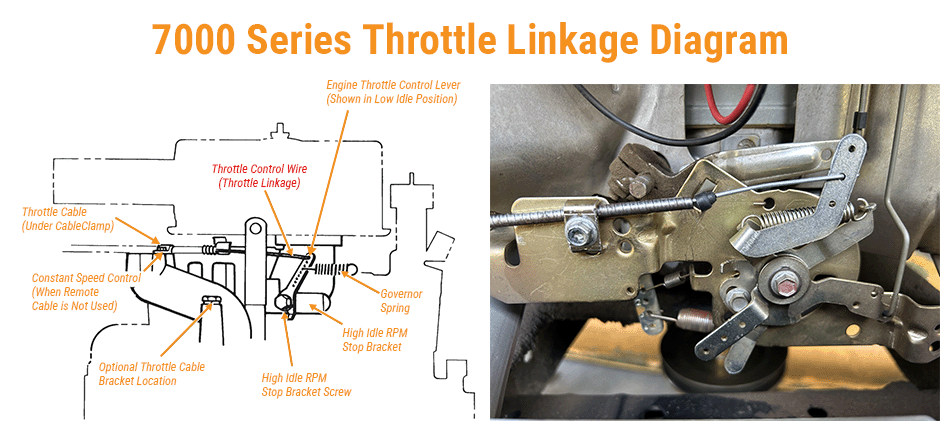
The images above show both a Kohler throttle linkage diagram and a real setup on an engine. The photo on the right shows the main parts, including the throttle cable, governor arm, and springs. The diagram on the left gives a closer look at each part and labels important components like the Governor Spring and High Idle RPM Stop Bracket.
The throttle linkage transfers movement from the throttle control to the carburetor. It also works with the governor to make small adjustments and help keep the engine running at a steady speed.
Kohler Courage 20 Throttle Linkage Diagram
The Kohler Courage 20 HP engine is another popular model with a slightly different linkage configuration. Understanding its specific layout is key to a successful repair.
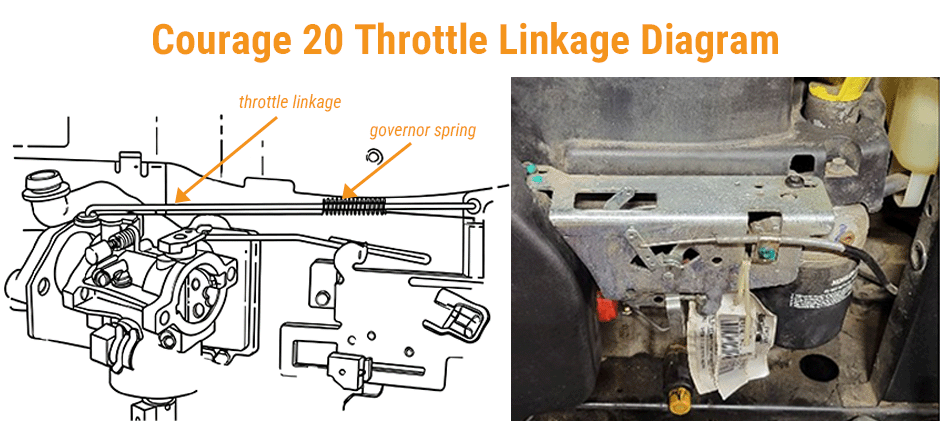
The photo on the right shows the linkage assembly installed on the side of the engine. The red arrow points to the governor arm and the connected rods and springs. The diagram on the left gives a simpler view of how these parts are connected.
The governor spring works with the governor inside the engine to help control engine speed. When the engine load changes, these parts work together to keep the engine running at a steady speed. Looking at both images together makes it easier to understand how the linkage system works.
How to Install the Throttle Linkage?
After a carburetor replacement or cleaning, you need to reassemble the throttle linkage. To get a clear view, you need to remove the air cleaner assembly. Removing a few nuts or screws holding the housing in place.
Identify the Linkages
There are two main linkages you’ll find: choke and throttle. The choke linkage hooks up to the choke plate on the carburetor — you only use it to start a cold engine. The throttle linkage connects the throttle plate and governor arm. It controls engine speed while the motor is running.
Connect the Throttle Rod
The main throttle rod is a short, stiff wire that connects the carburetor’s throttle lever to the governor arm.
- One end of the rod will pop into a hole on the carburetor’s throttle lever.
- The other end connects to the governor arm. Governor arms usually have several holes. The wrong hole will mess up how your engine speeds up and slows down. Take a photo of the original setup before you take anything apart.
Connect the Governor Springs
This spring controls how fast your engine runs. It links the governor arm to a fixed mount or throttle bracket. Spring tension decides the engine speed. Make sure you fasten it firmly into the correct holes.
Attach the Throttle Cable
- First, position your mower’s throttle control lever to the “FAST” or “HIGH” position.
- Insert the throttle wire into the correct hole on the engine’s throttle control lever or bracket.
- Pull the outer cable housing so it is taut (but not stretching the wire) and secure it under the cable clamp.
- Move the throttle control on your dashboard from slow to fast. You should see the engine’s control lever move smoothly from the low-idle stop to the high-idle stop bracket.
Once all the parts are connected, the linkage is installed. However, it still needs to be adjusted correctly to make sure the engine runs properly.
Throttle Linkage Adjustment
If your engine surges up and down, or struggles under load when you turn on the mower blades, adjusting the governor usually fixes it. This lines up the outer governor arm with the internal governor parts. This isn’t a regular maintenance step — only do it to fix this specific issue. Below is the common way to adjust a Kohler governor:
- Put throttle on full high: Slide your mower’s throttle lever all the way to fast. The spring will pull the governor linkage to hold the carb throttle fully open.
- Loosen the governor arm nut: Find the nut clamping the governor arm to the small governor shaft sticking out of the engine. Loosen it just enough so the arm spins separately from the shaft.
- Keep the throttle fully open: Check the carb linkage to confirm the throttle plate stays wide open, held tight by the spring from step one. All parts should sit at their maximum open position.
- Twist the governor shaft all the way open: Grab the small shaft with pliers, or stick a tiny tool into its hole to turn it. Spin it as far as it can go in the same direction as full throttle until it hits the built-in stop inside the engine.
- Lock the nut tight: Hold the shaft and linkage steady in this fully open spot while you tighten the arm’s clamp nut. Don’t let any parts shift while tightening.
This method matches the inner and outer governor parts perfectly. When the engine slows down under load, the governor will automatically open the throttle the right amount to keep steady speed.
Common Kohler Throttle Linkage Problems and Fixes
Your governor setup can still run into trouble even if you install everything right. Below are frequent issues and how to fix them.
- Engine surges up and down: This usually means your governor is out of adjustment. First redo the governor adjustment steps we covered earlier. If that still doesn’t work, your carb fuel jet might be partly blocked. It causes weak fuel flow, and the governor keeps surging to compensate.
- Engine can’t hit full speed: If the motor feels slow and won’t rev all the way, check your throttle cable setting. Slide the throttle lever to Fast, and make sure the linkage presses against the high speed stop bracket. If not, the cable is loose — tighten it at the cable clamp.
- Hard-to-move throttle lever: If the dash throttle lever sticks or is tough to push, the cable is almost always the culprit. Check for sharp bends or kinks on the cable housing. Spray penetrating oil or dedicated cable lube inside the housing to loosen it up. If it’s still stiff, the inner wire is frayed, and you need a new cable.
- Wrong reassembly: Most mistakes happen when you hook rods or springs into the wrong holes. Take clear photos from several angles before taking parts apart — this simple trick saves hours of guessing. You won’t waste time hunting for a Kohler throttle linkage diagram to match the original setup.
Conclusion
If you follow the linkage diagram, install parts the right way and tweak settings properly, you can fix most typical engine running problems. If you’re looking for replacement parts for your Kohler, FridayParts carries plenty of aftermarket components to get your repair done.
