

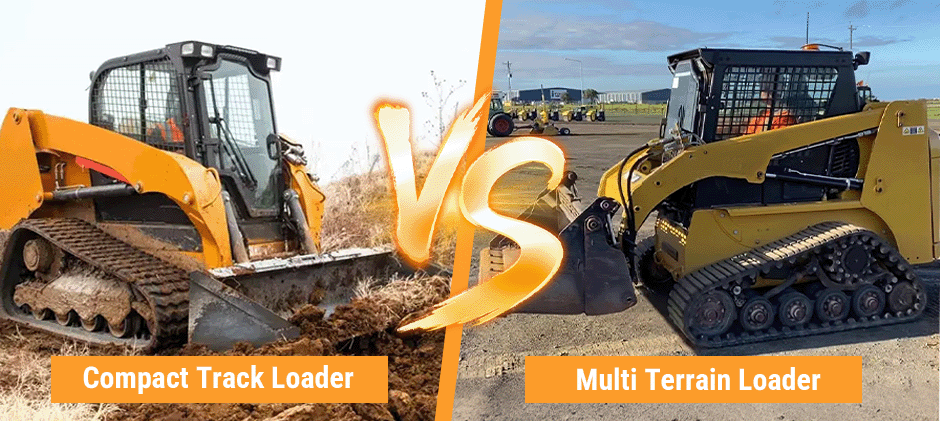
Compact track loaders (CTL) and multi-terrain loaders (MTL) are both popular types of track loaders. However, many people use the terms “compact track loader” and “multi-terrain loader” interchangeably. In this guide, we’ll walk you through the faceoff: CTL vs MTL to help you choose the right loader for your terrain.
Introduction to MTLs and CTLs
What Is A Compact Track Loader?
Compact track loaders (CTLs) are engineered to tackle a wide range of tasks with ease. Their rigid-mounted undercarriages and reinforced tracks make it a much heavier but much more durable machine for gravel and other tasks under harsh conditions. Equipped with a universal quick-attach system, CTLs can seamlessly connect with various attachments including buckets, forks, augers and brooms, making them suitable for various heavy workloads. Shop high-quality compact track loader parts here.
What Is A Multi-Terrain Loader?
Multi-terrain loaders (MTLs) are lightweight tracked loaders designed for lawns, established yards or environmentally conscious jobsites where low ground pressure and improved flotation are required. The suspended undercarriage and their non-reinforced tracks make it much lighter and faster while causing fewer disruptions to the surfaces they work on. The core functions of MTLs are similar to those of compact track loaders. They are equipped to handle a variety of attachments for tasks such as loading, digging, grading and site cleanup, making them highly versatile for construction, landscaping and agricultural applications.
Key Differences Between MTLs and CTLs
At first glance, compact track loaders and multi-terrain loaders look quite similar. They both use rubber tracks and support a wide range of attachments. However, they are designed for different working environments.
The main differences between CTLs and MTLs come from their undercarriage design, track construction, ground pressure, and flotation characteristics. These differences directly affect durability, traction, surface impact, and overall performance on different terrains.
MTL vs CTL Comparison Table
| Feature | MTL | CTL |
|---|---|---|
| Undercarriage | Suspended with rubber wheels or bogie wheels | Rigid-mounted, often steel rollers and idlers |
| Track Construction | Flexible rubber reinforced with internal cords | Commonly rubber tracks with steel embeds |
| Weight | Lightier | Heavier |
| Ground Pressure | Lower | Higher |
| Flotation | Excellent | Good |
| Traction | Better on soft terrain | Excellent on hard surfaces |
| Ride Comfort | Often smoother over uneven ground | Varies from firm to fully suspended |
| Durability | Lower in rocky conditions | Higher in abrasive environments |
| Sensitive Turf | Often the stronger option | Can work, but may cause more disturbance |
| Gravel and Hardpack | Suitable for limited or mixed use, depending on design | Often the stronger option |
| Sharp, abrasive terrain | May experience faster track damage | Usually better suited |
| Soft or wet ground | Strong flotation and low ground pressure | Can also perform well with wide tracks |
| Best Application | Landscaping, lawns, muddy terrains | Construction, demolition, grading |
Undercarriage Design
While the comparison table provides a quick overview of the main differences between CTLs and MTLs, understanding why these differences exist requires looking deeper into their design. The undercarriage system is one of the most important factors that determines how each loader performs in different working environments.
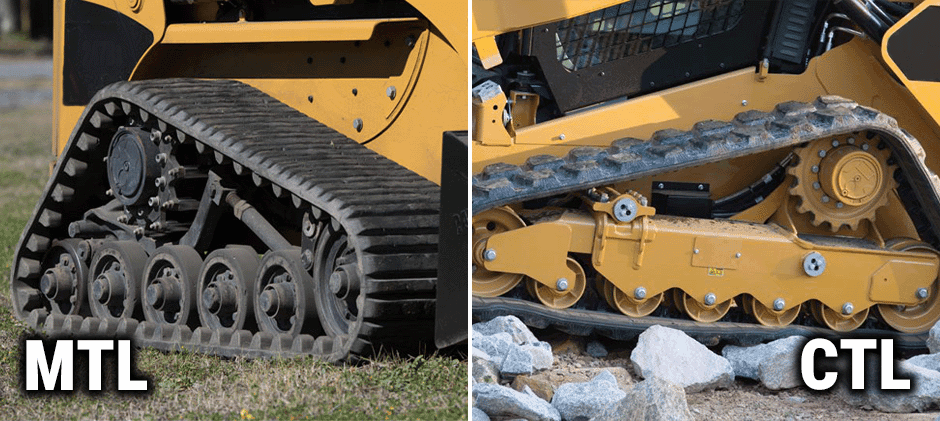
An undercarriage contains the following components:
The undercarriage design determines how a loader transfers power, handles impact, distributes weight, and performs on different surfaces. Shop Quality Undercarriage Parts for your track loaders.
CTL Undercarriage
CTLs usually use rigid-mounted undercarriages that provide:
- Better impact resistance
- Improved durability on rocks and gravel
- More efficient power transfer
- Better performance under heavy loads
The reinforced track structure helps prevent issues such as sprocket wear, drive lug skipping, and track damage in demanding environments.
MTL Undercarriage
MTLs typically use suspended undercarriages with the following benefits:
- More track contact with the ground
- Lower ground pressure
- Improved flotation
- Smoother ride quality
The flexible track system allows the machine to adapt better to uneven terrain while reducing damage to sensitive surfaces.
Ground Pressure and Flotation
The undercarriage design affects ground pressure and flotation, which determine how a loader performs on different surfaces.
Ground pressure refers to the amount of weight a machine applies to the surface it works on. Benefits of low ground pressure are:
- Less soil compaction
- Reduced turf damage
- Better performance in mud and soft soil
Flotation is a machine’s ability to stay on top of soft surfaces without sinking or causing excessive disruptions to the ground. Because MTLs typically have suspended undercarriages and greater track contact with the ground, they generally provide better flotation than CTLs.
Pros and Cons of MTL vs CTL Rubber Track
Here is detailed information regarding the merits and demerits of each track to help you guide your purchasing decision.
Compact Track Loader Rubber Tracks
Pros
- More durable in rocky and abrasive environments due to reinforced track
- Better power transfer with reduced risk of sprocket and drive lug or pin skipping or slipping
- Longer track life in harsh working conditions
- More track patterns and options for different applications
Cons
- Less traction than MTL tracks
- Higher ground pressure compared with MTLs
- Heavier machine weight may reduce fuel efficiency
- More likely to disturb delicate surfaces
Multi Terrain Loader Rubber Tracks
Pros
- Excellent flotation on soft and muddy terrain
- Lower ground pressure and reduced surface damage
- More grip and traction on soft surfaces
- Flexible tracks for a smoother ride
- Better choice for landscaping and environmentally sensitive jobsites
Cons
- Tracks are more vulnerable in rocky environments
- Drive lugs may skip and pop off due to reduced internal reinforcement
- More expensive undercarriage system and maintenance costs
CTL vs MTL: Which Loader Is Better for Your Terrain and Work?
Different industries place different demands on a track loader. The following recommendations are starting points. The final choice should be based on the actual model, attachments, and jobsite.
| Who You Are | Choose MTL | Choose CTL |
|---|---|---|
| Landscraper | Moving topsoil Grading yards Installing sod Carrying landscape materials Working in parks Crossing finished property Operating after wet weather |
Hardscraping Retaining walls Acreage clearing Heavy excavation |
| General Contractors | / | Gravel Packed fill Construction debris Rough access roads Foundation sites Commercial properties Mixed surfaces |
| Residential Contractors | Finished properties | / |
| Snow-Removal Contractors | Soft properties, trails, or locations where ground pressure matters. | Snow work that needs durability, lifting capacity, and attachment options |
| Farmers | Soft fields Livestock areas Wet ground Yard maintenance Jobs where rutting matters |
Gravel yards Feedlots Concrete lanes Snow removal Material handling Heavy attachments Brush clearing |
| Forestry & Land-Clearing Crews | / | Forestry and land clearing that involve rock, stumps, branches, uneven terrain, and high-demand hydraulic attachments. |
| Municipal & Property-Maintenance Crews | When parks, lawns, trails, and soft ground account for most of the work | For broad, year-round use of snow removal, park work, trail maintenance, material handling, road repair, landscape maintenance, street sweeping, loading trucks |
Should You Buy or Rent An MTL or CTL?
Once you know which machine fits the work, you still need to decide whether to own it. Buying can make sense for a machine that works regularly and generates dependable revenue, while renting can make sense for temporary, changing, seasonal, or uncertain needs.
Consider Buying When:
- The machine is for year-round use
- You have steady work for it
- Your work requires the same size and configuration
- Rental availability causes scheduling problems
- You have operators who know the machine
- You can manage maintenance and repairs
- The machine will support several attachments
- You have enough storage
- Ownership fits your cash flow and financing plan
- The machine can be equipped, maintained, and set up for your regular work
Otherwise, owning a loader can bring about expensive purchase costs, equipment depreciation, costly insurance, high maintenance and repair bills, downtime risk and revenue loss.
Consider Renting When:
- The machine is for a single project
- You only use it a few times each year
- Your machine-size needs change by job
- You need a specialized attachment
- You do not have storage
- You do not want to manage long-term maintenance
- You want to preserve cash for other business needs
In this way, you can enjoy flexibility, lower initial spending, reduced long-term commitment, and less maintenance responsibility among the common benefits of renting heavy equipment.
Final Takeaways
There is no single best choice between a compact track loader (CTL) and a multi-terrain loader (MTL). The right loader depends on your terrain, workload, and job requirements. Choose a CTL for heavy-duty applications that require durability, power, and performance on rough surfaces, or choose an MTL for soft terrain, landscaping, and jobs where low ground pressure and surface protection are priorities. By understanding your work conditions and attachment needs, you can select the loader that delivers the best productivity and value for your operation. At FridayParts, you can explore a vast range of loader replacement parts and undercarriage parts to keep your loader back to its optimal performance. Enjoy your fantastic ride now!
