

Turning the key on the riding mower, and being met with complete silence or a weak click. Don’t worry. When a riding mower won’t turn over, the cause is often a simple electrical issue you can diagnose and fix yourself.
What Does “Won’t Turn Over” Mean on a Riding Mower?
Before we dive into troubleshooting, we need to clarify our terms. In the world of engines, “won’t turn over” and “won’t start” describe two very different problems. This distinction is the most important first step in your diagnosis.
- Won’t Turn Over: When you twist the key, the starter can’t spin the engine’s crankshaft. You may hear one loud click, a fast series of clicks, or complete silence. You won’t get that rumbling chug sound the engine makes when it tries to fire up.
- Turns Over but Won’t Start: The starter spins the engine loud and clear, but it never catches and keeps running on its own. This issue stems from fuel, air or spark problems — your starter system itself is fine.
This article focuses exclusively on the first scenario: your riding mower won’t turn over.
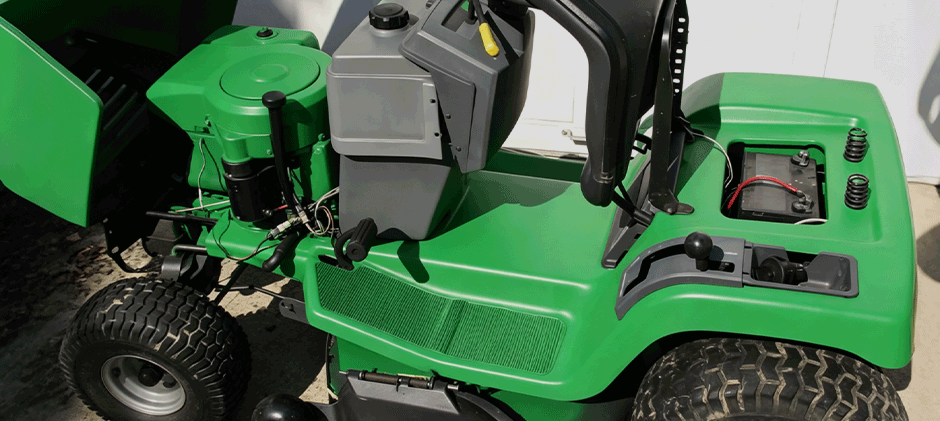
Why Won’t My Riding Mower Turn Over? No Click vs. Clicking
The noise your mower makes (or doesn’t make) when you twist the key is the biggest hint to what’s wrong. It immediately cuts down your list of possible issues and shows you where to start troubleshooting.
Situation 1: No Sound at All when you turn the key
If it’s totally silent, the electrical start signal gets blocked before it reaches the starter solenoid. The low-power starting circuit has a fault somewhere. Typical reasons for complete silence:
- Safety switches tripped: You didn’t push the brake pedal down, the blade PTO switch is turned on, or the seat sensor can’t detect you sitting on the mower.
- Fully dead battery: The battery has zero power left to trigger the solenoid.
- Blown main fuse: The fuse burned out to shield the wiring from damage.
- Broken ignition switch: The key switch failed and can’t send the signal to start the engine.
- Damaged wiring: A wire in the starting circuit snapped loose or broke entirely.
Situation 2: One loud single click after turning the key
One click is actually a small relief. It proves your battery still holds some charge, all safety switches work, the ignition switch is good, and the solenoid gets the start signal and tries to kick in. The trouble is with the high-power wiring that feeds the starter motor enough juice to spin the engine. Common causes for one single click:
- Weak battery: It’s got just enough power to trigger the solenoid click, but not enough to spin the heavy starter motor.
- Loose or corroded battery cables: This happens all the time. Main battery wires (especially the ground wire bolted to the mower frame) can’t carry the heavy current the starter needs.
- Worn-out solenoid: The solenoid clicks, but its internal metal contacts are worn down and can’t pass power to the starter.
- Failed starter motor: The starter itself seized up or stopped working.
Situation 3: Fast, rapid clicking or chattering noise
This noise almost always means your battery is weak or nearly dead. The solenoid clicks on, the starter tries to pull power, and the battery’s voltage drops sharply. The low voltage immediately shuts the solenoid off. Once it cuts off, the battery voltage bounces back, and this loop repeats super fast to create that chattering sound.
How to Troubleshoot a Riding Mower That Won’t Turn Over?
Now let’s walk through a safe, easy troubleshooting routine using everything we just covered. Before you start, park the mower on flat ground, set the parking brake, and pull the key out of the ignition.
Step 1: Quick Safety Switch Check
Grab no tools yet — go through these easy fixes that cause most no-start issues.
- Make sure the PTO blade switch or lever is fully turned off.
- Sit all the way down in the seat to trigger the seat safety sensor.
- Push the brake/clutch pedal all the way down and hold it while trying to start the mower.
If it fires up right away, you’re all set. If not, move on to Step 2.
Step 2: Check the Battery and Its Wires
Most starting faults stem right here. Grab a wire brush and a multimeter (or a 12V test light).
- Quick visual check: Look over the battery. If you spot cracks, fluid leaks, or a swollen case, toss it and get a new one.
- Clean battery terminals: Disconnect the black negative wire first, then the red positive wire. Scrub the battery posts and the insides of the cable clamps with your wire brush until all corrosion is gone and metal shines bright. Even a thin white crust can block electric power.
- Clean the ground connection: Follow the black negative wire to where it bolts onto the mower’s metal frame — this connection is super important. Unbolt it, scrub the frame metal and cable end clean with the brush, then bolt it back tight.
- Test battery voltage: Hook the red positive cable back on first, then the black negative one. Switch your multimeter to DC Volts. Touch the red meter lead to the positive battery post, black lead to the negative post.
- 12.6V or above: Battery is fully charged and in good shape
- 12.2V to 12.5V: Battery is low and needs charging
- Under 12.2V: Battery is heavily drained or worn out
- Do a load test: A basic voltage reading doesn’t tell the full story. A battery might hit 12.6V sitting idle but die when the starter draws power. If you think your battery’s faulty, most auto parts shops will run a free load test to check its condition.
Step 3: Inspect the Main Fuse
Nearly all riding mowers have a main fuse, usually tucked in a small plastic holder near the battery or starter solenoid. Pull the fuse out and hold it up to light. If the thin metal strip inside is snapped, the fuse blew. Replace it with a new fuse with the exact same amp rating only.
Step 4: Test the Solenoid and Starter Motor
We’ll figure out if the solenoid or starter is broken here. Important note: these tests skip the safety switches. Make sure the mower’s in neutral and the blade PTO is off before you start.
Solenoid Bypass Test (for Clicking Noises)
Your starter solenoid has two big terminals for the main battery wires, plus one or two small terminals for the ignition signal wire. Grab an insulated-handle screwdriver, then briefly touch the two large posts together to bridge them.
- If the engine cranks: Your starter works fine — the solenoid is broken.
- If nothing moves (only a spark pops up): The starter motor or the heavy wire linking the solenoid to the starter is faulty.
Direct Starter Test
If you want to double-check a suspect starter, use a jumper cable to send power straight to it. Clip one end of the jumper cable to the battery’s positive post, then tap the other end onto the large terminal on the starter where the solenoid wire attaches.
- If the engine cranks, the starter is good. The trouble lies earlier in the circuit — a bad solenoid or a damaged wire between the solenoid and the starter.
- If you only get sparks and no cranking: The starter motor needs replacing, or the engine’s locked up mechanically.
Step 5: All Electrical Parts Check Out, But It Still Won’t Crank
If every electrical test passes and the starter still can’t spin the engine, you’ve got a mechanical problem on your hands.
-
Locked/seized engine (major issue): First pull out all spark plugs to let cylinder compression escape. Next, try twisting the flywheel screen on top of the engine by hand. If it won’t turn at all, the engine’s seized — usually from low oil or severe internal damage.
-
Broken compression release: Many engines have a small camshaft part that slightly opens a valve to cut compression, making the engine easier to crank. If this piece fails, the starter has to fight full compression pressure. It’ll act just like a weak battery or faulty starter: it’ll struggle to spin, then grind to a sudden stop. If you’ve already swapped out the battery and starter and still have this issue, the compression release is likely broken. Fixing this means taking apart the engine, so it’s a more complex repair.
Conclusion
When your riding mower won’t turn over, you can often find and fix the problem yourself. In many cases, simply cleaning corroded battery terminals or replacing a blown fuse can get it running again.
If you find that the starter or solenoid is bad, you don’t have to pay dealer prices for replacement parts. FridayParts can help you find the right parts and get your mower back up and running without spending too much.
