

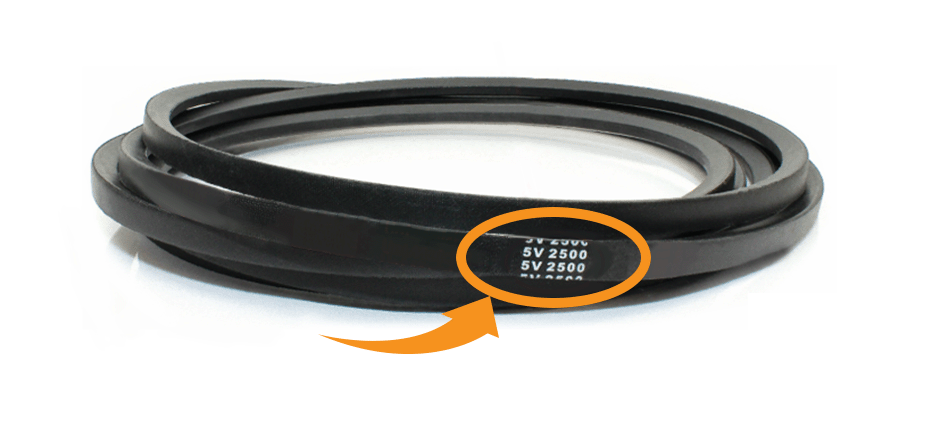
When a V-belt on your machine breaks, finding the right replacement can be tricky. Every V-belt has a set of letters and numbers printed on its side, and this code tells you exactly which belt you need. This guide shows you how to read V-belt numbers to buy a perfect replacement belt. It also explains how to measure a V-belt if the code is worn off.
How to Read V-Belt Numbers?
Every V-belt part number is a quick reference for two key specs: the belt’s cross-section profile and its length.
The profile refers to the belt’s width and shape, which decides whether it fits the pulley groove perfectly. The number for length stands for the belt’s circumference. The tricky part is that length measurements and units vary by belt type — some use inner length, some outer length, and others pitch length, in either inches or millimeters. Below are the simplest rules to read all common V-belt codes:
1. Standard Classical V-Belts (A / B / C / D / E)
These are the universal, all-purpose belts widely used on farm equipment and industrial machinery. They come in five standard section sizes: A, B, C, D and E.
Coding rule: Section letter + inside length (Li) in inches
Example: B98
B = B-section classical belt (top width: ~21/32 inch / 17mm)
98 = 98 inches inside circumference
2. Narrow Wedge V-Belts (3V / 5V / 8V)
These belts feature a deeper, narrower V-shape. They deliver higher power in a smaller size, making them perfect for compact machines and heavy-load operations. Common sections are 3V, 5V and 8V.
Coding rule: Section code + outside length (La) in tenths of an inch (divide the number by 10 for inches)
Example: 5V500
5V = 5V-section narrow wedge belt (top width: ~5/8 inch / 15.8mm)
500 = 50 inches outside circumference (500 ÷ 10 = 50)
3. Metric Wedge Belts (SPZ / SPA / SPB / SPC)
These are metric-sized wedge belts, mostly used on non-North American machinery. The full standard section range includes SPZ, SPA, SPB and SPC.
Coding rule: Section code + pitch length (Lp) in millimeters
Pitch length is measured along the internal reinforcing cords inside the belt — the most accurate reference for replacement.
Example: SPA1500
SPA = SPA-section metric wedge belt (top width: 12.7mm)
1500 = 1500mm pitch length
For reference, SPA732 means the same SPA belt profile with a 732mm pitch length.
4. Hybrid Detailed Part Numbers
Many manufacturers use hybrid codes that combine metric dimensions and standard industry numbers. This dual-reference design avoids matching errors and is super helpful for replacement.
Example: 13*3048La (A118)
13 = 13mm top width, matching a standard A-section belt
3048La = 3048mm outside length
(A118) = equivalent standard part number: A-section, 118-inch inside length (A-section belts with 3048mm outer length correspond to 118-inch inner length)
5. Common Suffix: “X” for Cogged Belts
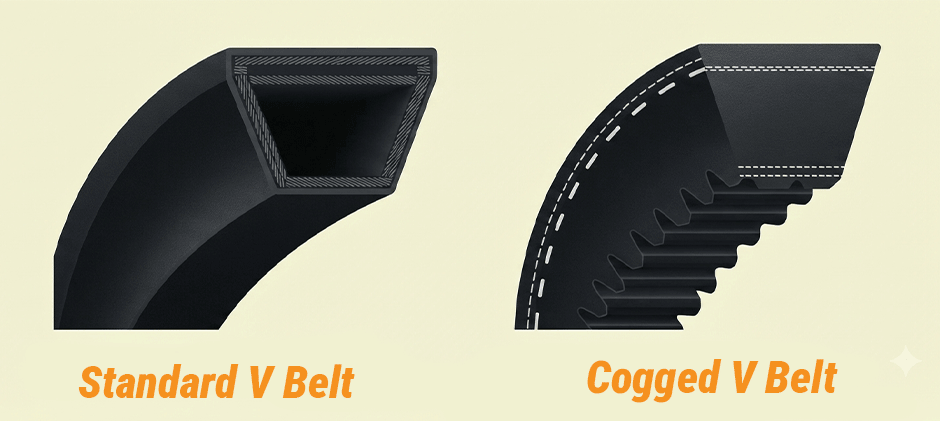
You’ll often see an “X” at the end of belt codes, such as BX98 or 5VX500. This suffix means the belt is cogged/notched. Compared to standard wrapped belts, cogged belts are more flexible, run cooler, and work more efficiently on machines with small pulleys.
How to Measure a V-Belt If the Numbers Are Gone?
Over time, the part number on a V-belt can wear away completely. In this situation, you’ll need to do a manual V-belt measurement to identify the correct replacement. This is a two-step process: first identify the section, then the length.
Step 1: Identify the Cross-Section
You cannot determine the length without first knowing the section. Use a caliper for an accurate measurement of the belt’s top width and height (depth). A simple tape measure is not precise enough.
Once you have these two measurements, compare them to a V-belt width chart to find the corresponding section.
| Section | Top Width (in) | Top Width (mm) |
|---|---|---|
| 3L | 3/8″ | 9.5 mm |
| A (4L) | 1/2″ | 13 mm |
| B (5L) | 21/32″ | 17 mm |
| C | 7/8″ | 22 mm |
| 3V | 3/8″ | 9.7 mm |
| 5V | 5/8″ | 15.8 mm |
Step 2: Measure the Length and Convert
Once you know the section, you can measure for length. The most reliable method is to measure the outer circumference (Lo). Use a flexible measuring tape or mark a spot on the belt, lay it on a flat surface, and roll it one full revolution while marking the start and end points.
Now, you must convert this outer length to the nominal length used for ordering. For classical belts (A, B, C), this means converting to the inside length (Li). Use the following industry-standard deduction constants:
- A-Section: Subtract 2 inches from the outer length.
- B-Section: Subtract 3 inches from the outer length.
- C-Section: Subtract 4 inches from the outer length.
Example: You measure a belt and find its top width is 21/32″, making it a B-section. You then measure its outer circumference and get 101 inches. To find the part number, you subtract the B-section constant:
101″ (Outer Length) – 3″ (B-Section Constant) = 98″ (Inside Length)
Your replacement belt is a B98.
How to Buy the Correct Replacement Belt?
Reading the belt part number gets you most of the way there, but there are a few quick checks to make sure you get the perfect belt for your setup.
Match the belt section to your pulley grooves: V-belts work by wedging tightly against the sides of the pulley groove. If the belt is too narrow, it sits too deep inside the groove and loses traction. If it’s too wide, it sits too high, slips easily, and wears out fast. Always double-check the profile size is a perfect fit.
The right belt construction: If your machine has small pulleys, go with a cogged belt (BX, 5VX, etc.). The notches make the belt more flexible, reduce heat buildup, and help it last much longer during constant bending. Standard wrapped belts are the better option for dusty, dirty, or abrasive working conditions, as they offer better overall wear resistance.
Use banded belts for heavy-duty setups: For high-load, shock-duty applications, or setups with a long distance between pulleys, choose a banded belt. These are multiple individual V-belts bonded together with a shared backing. This stops single belts from twisting, slipping, or jumping out of the grooves. The part number tells you the rib count. For example, 3/5V500 means a 3-rib banded belt made with standard 5V-section belts.
Conclusion
Learn how to read V-belt codes properly. Just match the belt profile, length and build style to what your machine needs. If the markings on your old belt have worn off, accurately measure its width and total length to get all the specs you need. At FridayParts, we supply durable, budget-friendly replacement parts with a huge stock on hand. Our V-belts fit machinery from most major brands, so you can always get a match for your equipment.
